case study
Personal Finance Tracker
Android app · Kotlin & Firebase
- Role
- Sole developer
- Platform
- Native Android app · Kotlin · Android 8.0+
- Back end
- Firebase Auth and Realtime Database – no custom server
- Quality
- Functional test cases on all core flows – all passed
- Kotlin
- Android SDK
- Firebase
- MVVM
The goal
An everyday finance tracker with a clean interface, where recording a transaction takes only a few taps, the balance between money earned and money spent is visible at a glance, and the data follows the account across devices.
What it does
- Accounts. Sign-up and login with email and password or with Google, email confirmation, password recovery, sign-out and a custom profile picture.
- Transactions. Add income or expenses with an amount, category, date and description; edit or delete them later.
- History. The list shows the newest first and filters by type and time span.
- Insight. Totals for the selected period and pie and bar charts that compare spending with income.
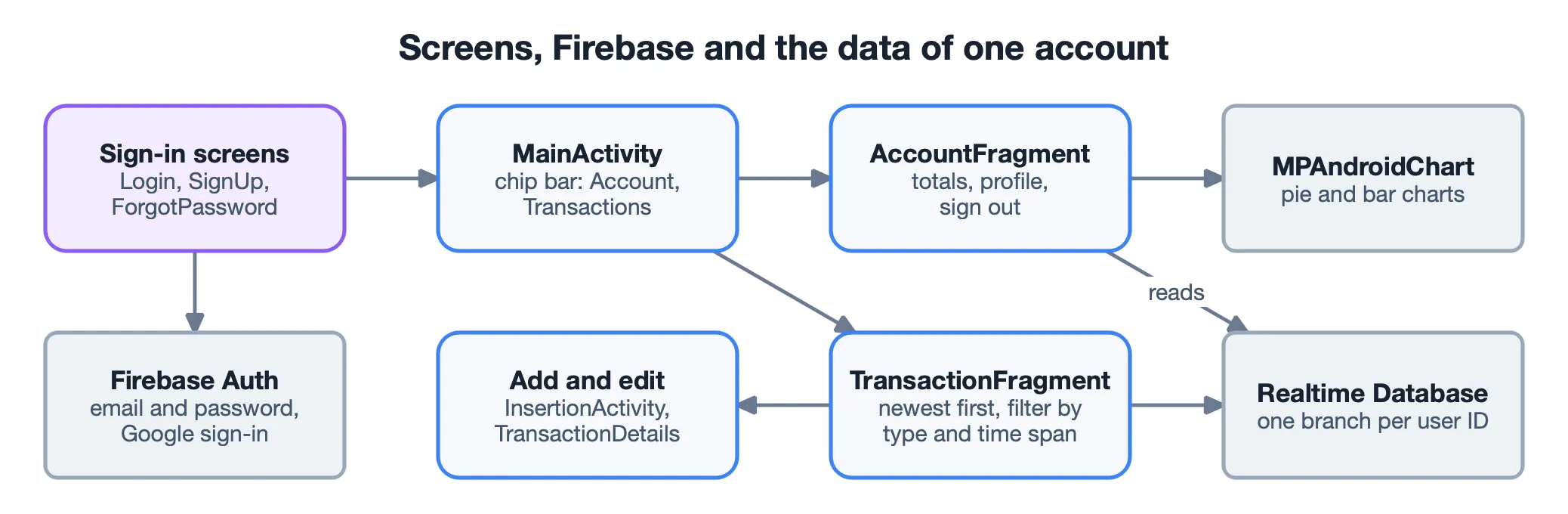
How it is built
Firebase as the whole back end. Firebase Authentication handles the accounts, including Google sign-in. Each user’s transactions live in their own branch of the Realtime Database, under the user ID, so one account never reads another’s data and the same data appears on every device.
Live data on screen. The transaction list listens to the database, so a change shows up without a manual refresh; the account screen also refreshes with a swipe.
Screens split by job. A main activity with a chip bar switches between an account fragment and a transactions fragment; adding and editing a transaction have their own screens. The charts are drawn with MPAndroidChart.
Testing
Functional test cases covered registration, login, adding, editing, deleting and sorting transactions, and synchronization, comparing the real behaviour with the written requirements. All passed.