case study
HYBRIDEA
Hybrid RL/IL game-AI agent · MSc thesis
- Role
- Sole author – MSc thesis, practical part
- Result
- Best of six agents: mean 1658.84, max 3890
- Setup
- 500 episodes per agent · Mac mini M4 with PyTorch MPS
- Published
- Two international conferences – Odesa 2025, Sofia 2026
- Python
- PyTorch
- OpenAI Gym
- Reinforcement Learning
- Behavioral Cloning
The problem
Reinforcement learning from a cold start is slow and unstable: an agent explores at random and makes the same mistakes for a long time before it improves. Imitation learning starts well but stops at the level of the expert it copies. The thesis asked whether a hybrid of the two can learn level-completion strategies faster and better than either – using Ms. Pac-Man as the test environment for NPC behaviour in games.
What I built
Six agents, implemented and benchmarked under the same conditions: DQN, PPO, A2C, Monte Carlo, Behavioral Cloning, and the project’s own contribution, HYBRIDEA.
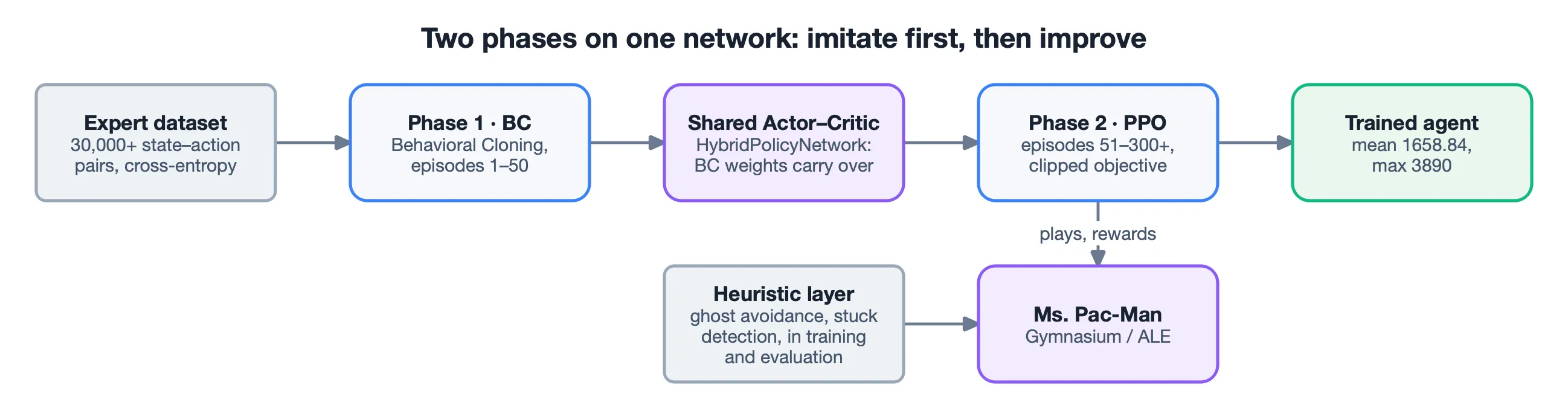
- Phase 1 – Behavioral Cloning (episodes 1–50). The agent learns from 30,000+ expert state–action pairs with a cross-entropy loss, so it navigates safely from the start instead of exploring at random.
- Phase 2 – PPO (episodes 51–300+). The same network keeps training by playing, with PPO’s clipped objective and advantage estimation, so it can improve on the expert instead of only copying it.
- A heuristic layer – ghost avoidance and stuck-state detection – keeps behaviour stable in both training and evaluation.
The network
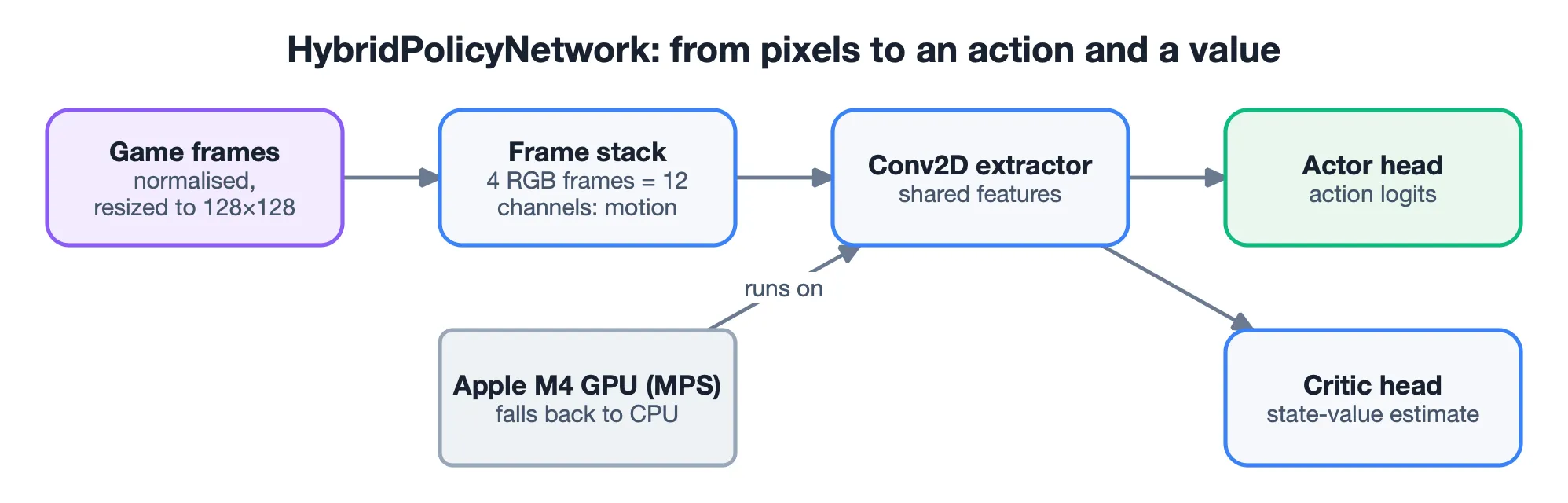
HybridPolicyNetwork is a shared Actor–Critic. Game frames are normalised, resized to
128×128 and stacked four at a time into 12 channels, which gives the model motion context.
A Conv2D feature extractor feeds two heads: the Actor gives the action logits, the Critic
estimates the value of the state. Training runs on the Apple M4 GPU through Metal
Performance Shaders and falls back to the CPU.
Results
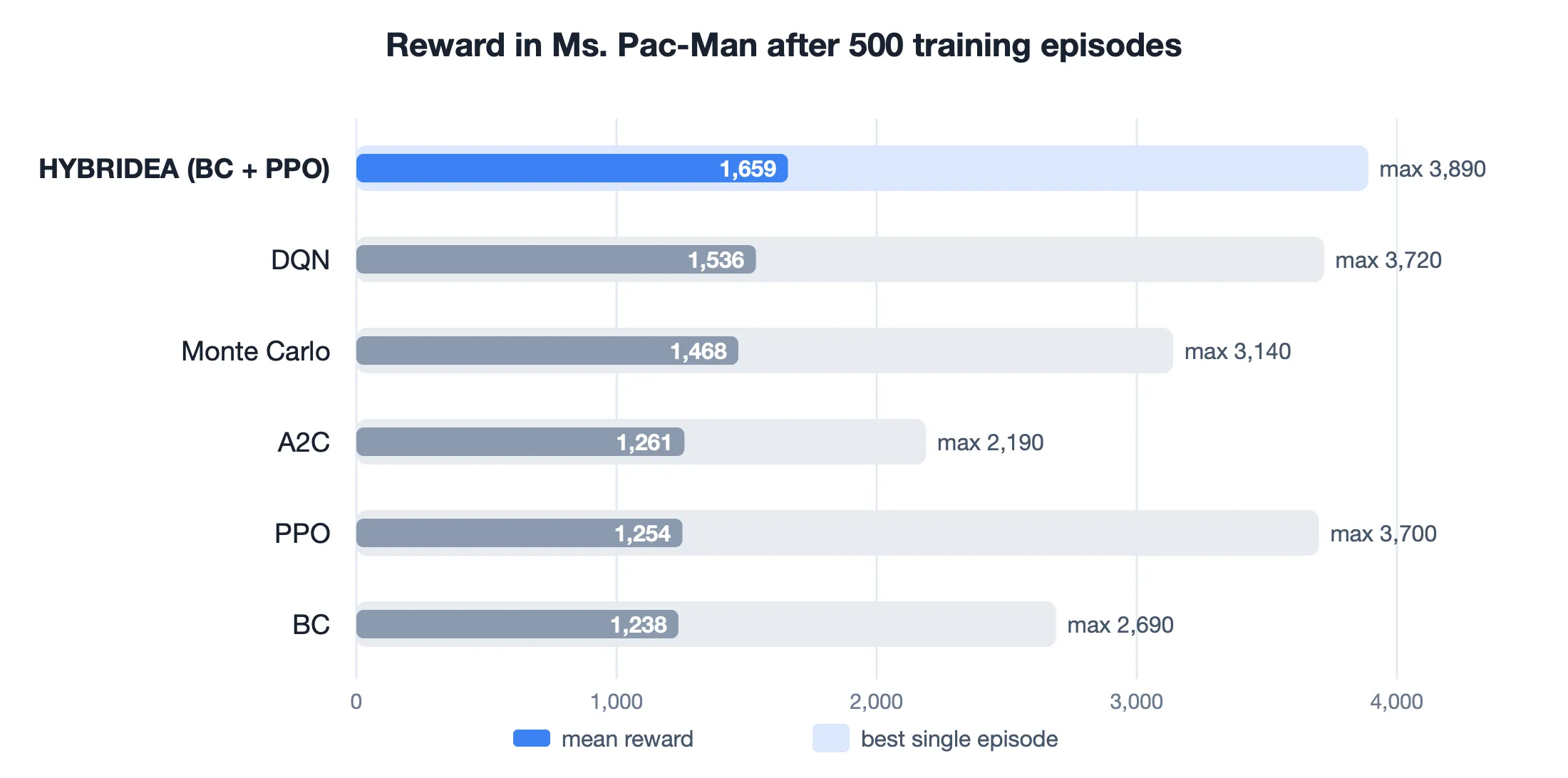
HYBRIDEA had the best mean reward of all six agents – about 8% above DQN, the strongest single method, and about 32% above plain PPO – and also the highest single-episode score. It scored above the Behavioral Cloning agent built from the same expert data, which is the point of the hybrid: the demonstrations are a starting line, not a ceiling.
Engineering
- A reproducible pipeline. One entry point selects the algorithm and the device; the pipeline saves checkpoints, logs runs, plots loss and reward curves, and writes evaluation reports.
- Fair comparison. Every agent trained for 500 episodes and was measured on the same metrics: mean and max reward, reward distribution, step consistency and score variance. Each model took about 2–3 hours to train on a Mac mini M4.
- Custom environment. A Gymnasium-compliant Ms. Pac-Man environment over the Arcade Learning Environment, with reward logic and maze configuration in YAML.